Whats difference for the Cores of CNC Manual Coffee Grinder? 5 Cores 6 cores and 7 Cores.
The grinding cores of CNC hand-cranked coffee grinders are classified into types such as five-star, six-star, and seven-star according to the number of cutting heads. The core differences are reflected in aspects such as the number of cutting heads, grinding efficiency, applicable scenarios, and grinding uniformity.
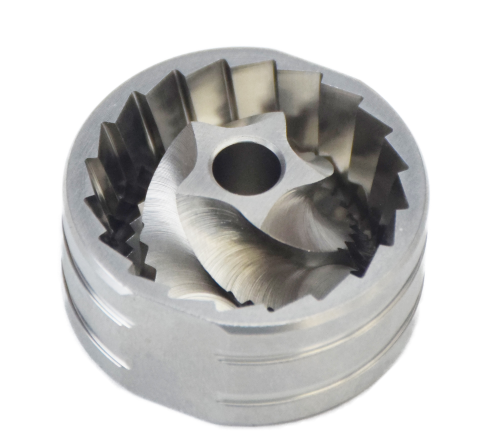
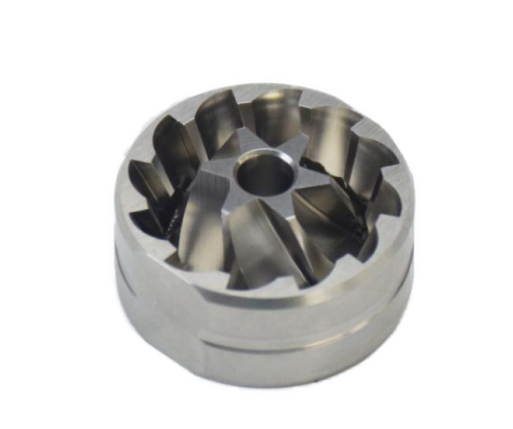
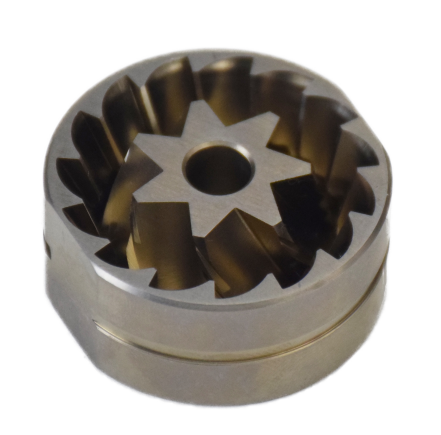
The following is a specific analysis:
- Six-star Grinding Core: It uses 6 cutting heads, which are usually arranged in a regular hexagon around the central circle, and the cutting heads are on the same horizontal plane.
- Seven-star Grinding Core: It is equipped with 7 cutting heads, which are distributed in a spiral upward manner along the main shaft, forming a multi-level cutting structure and increasing the grinding contact surface.
- Five-star Grinding Core : 5 cutting heads, suitable for more basic grinding needs.
- Seven-star Grinding Core: Due to the larger number of cutting heads and the spiral arrangement, the grinding speed is faster and the fineness is higher, which can reduce the granular feeling. It is suitable for brewing methods that require extremely fine powder, such as Italian espresso.
- Six-star Grinding Core: The grinding efficiency is slightly lower, and the uniformity is better, but the fineness is limited. User tests show that even when adjusted to the finest gear, it may still not be able to meet the needs of Italian espresso. It is more suitable for methods with higher tolerance for coarse powder, such as pour-over coffee and French press.
- Five-star Grinding Core: It is speculated that the grinding efficiency is lower and may be suitable for coarse grinding scenarios (such as cold brew).
- Seven-star Grinding Core: It is suitable for professional users or coffee lovers who pursue a delicate taste, especially performing better in scenarios such as Italian espresso and Turkish coffee.
- Six-star Grinding Core: It balances portability and cost-effectiveness, and is suitable for daily home use or travel. However, attention should be paid to the limitation of fineness (such as user feedback that it cannot meet the needs of espresso).
- Five-star Grinding Core: It may be targeted at the entry-level market, suitable for users with limited budgets or those who have low requirements for grinding.
- Seven-star Grinding Core: Due to its complex structure and a larger number of cutting heads, it has higher requirements for materials (such as 420 steel and ceramics) and machining accuracy (CNC process), and has better long-term use stability.
- Six-star Grinding Core: It is commonly found in mid-range models (such as ZIGO and Wise C1), using 7075 aluminum tubes or CNC steel cores, with medium durability. However, some users have feedback on the problem of insufficient fineness.
- Seven-star Grinding Core: The price is usually higher than that of the six-star. For example, the seven-star model of the same brand is 30-50% more expensive than the six-star model.
- Six-star Grinding Core: It has outstanding cost-effectiveness. For example, the promotional price of the six-core model of ZIGO can be as low as 75 yuan, but the limitation of fineness needs to be accepted.
- Purchase Suggestions:
- If you pursue extremely fine powder (such as for espresso), give priority to the seven-star model.
- If you focus on portability and daily use, the six-star model is more practical.
- The five-star model is suitable for users with limited budgets or those with coarse grinding needs.
The number of cutting heads and the layout are the core factors that distinguish different star-level grinding cores, directly affecting the grinding efficiency and fineness. The seven-star model has an advantage in professionalism and fineness, the six-star model balances cost-effectiveness and portability, and the five-star model leans towards basic functions. When purchasing, it is necessary to comprehensively consider your own brewing method (such as the need for a seven-star model for espresso) and budget.


